Pursuits list
Overview
The Pursuits page is your team's bid pipeline — every active workspace where you prepare submissions, track outcomes, and report estimated value. Cards appear on a kanban board grouped by status: Active, Bid submitted, Won, and Lost. Drag cards between columns as the bid progresses, filter by deadline or owner, and open any pursuit to work in questionnaire, offers, and documents.
Pursuits are the execution layer of Tendersight. Notices in Opportunities answer what is for sale; pursuits answer how your team will win. Every pursuit you create — from a synced notice or as a standalone workspace — lands here in Active until you move it forward.
Tip: Before you rely on the board for pipeline reporting, confirm you have:
Selected the correct active team in the sidebar (boards are per team)
Assigned an owner on each card you care about for filtering
Set deadline and estimated value on pursuits (standalone ones need manual entry)
Completed Team → Settings so downstream document modules auto-fill legal data
Populated Team → Inventory → Products if technical offers will import catalog items
The cleaner your pursuit metadata, the more useful filters, pipeline totals, and team overview checklists become.
Important: Deleting a pursuit from the card menu is permanent. It removes requirements, offers, uploaded documents, and checklists for that workspace. There is no undo.
Pursuit board vs notice catalog

See Notice (Tender) for the market-intelligence side of this relationship.
How to open
Page title: Pursuits in {team name}
Two ways pursuits arrive on the board
Not every card starts the same way. Both paths use the same kanban and modules afterward.
Path A — From a synced notice (recommended when indexed)
Use when the opportunity appears under Opportunities → Notices or matched an alert.
Open the notice from browse, alert, or Home assistant.
On Notice overview, confirm latest version, deadline, lots, and documents.
Click Create pursuit in the command bar (or Go to pursuit if your team already has one).
If you belong to multiple teams, pick the owning team.
The new card appears in Active with notice identifier, authority link, and copied deadline/value.
See Create pursuit from notice.
Path B — Standalone pursuit
Use when the buyer sent documents by email, the tender sits on an unmonitored portal, or you respond to a private RFP.
On Team → Pursuits, click New standalone pursuit in the toolbar.
Complete the three-step wizard: Details → Documents → Review.
The card appears in Active with Source: standalone — no official notice identifier unless you typed authority details.
See Create standalone pursuit.
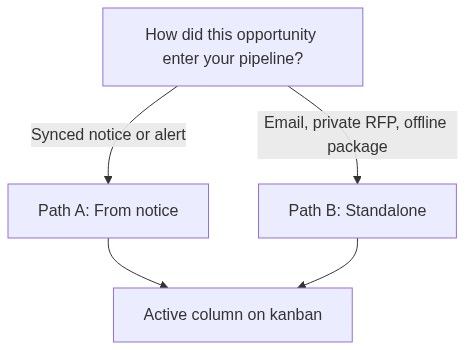
Caution: Choosing standalone when the notice is in the catalog means you lose automatic version tracking, official identifier links, and one-click Go to pursuit from the notice page. Prefer Path A whenever the tender is indexed.
Toolbar and filters
The page header splits into filters (left) and actions (right).
Filters
Applied filters update shortly after you stop changing filters.
Already-applied filter types show a checkmark in the New filter menu and cannot be added twice.
Primary action
Kanban columns
Four columns, left to right:
Each column header shows:
Status label
Pipeline value — sum of estimated values in that column
Count badge — number of cards
Drag-and-drop
Drag cards between columns to update status. The drop zone highlights while dragging.
Horizontal scroll on the board — drag empty space to pan wide pipelines
Load more at column bottom when results are paginated
Empty column: archive icon + "No pursuits in this status"
Initial load: four-column loading placeholder with placeholder cards
Tip: Update status when the outcome is known — Won and Lost columns feed team reporting and keep Active focused on live bids.
Pursuit card anatomy
Each card summarizes the workspace at a glance:
Card actions menu
Open via ⋮ on any card:
Delete confirmation warns that the entire workspace — requirements, offers, documents — will be removed. This action is irreversible.
Standalone vs notice-linked on the board
You cannot merge a standalone pursuit onto a notice later. If the tender appears in the catalog, create a new notice-linked pursuit.
Recommended workflow on the board
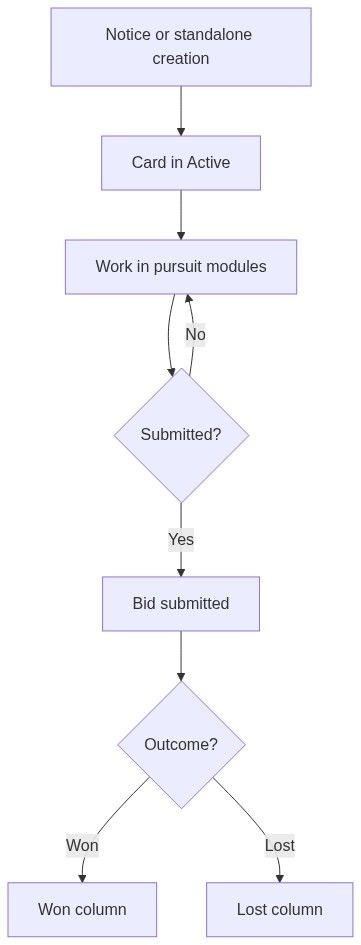
Discover — notice browse, alert, or offline package.
Create — Path A or Path B; card lands in Active.
Execute — questionnaire, in-depth analysis, offers, documents (First pursuit workflow).
Submit — drag to Bid submitted when the package leaves your team.
Close — drag to Won or Lost when the authority decides.
Permissions snapshot
\*Depends on team policy for pursuit management.
Full matrix: Permissions and access.
Subscription gates
When the plan limit is reached, creation fails with an upgrade message — existing cards remain visible.
What you can and cannot do on the board
You can
Filter by deadline, value, owner, status, and source
Drag cards to update pipeline stage
Reassign owner from the card menu
Open pursuit overview via card title link
Start a standalone pursuit from the toolbar
You cannot
Edit notice data from the pursuits board
Share one pursuit across two teams on the same notice
Recover a deleted pursuit
See another team's pursuits while viewing your team's board
FAQ
What is the difference between pursuit and project?
Same workspace. Project appears in some translations and assistant phrasing; pursuit is the primary English label on Team → Pursuits.
Why does my card show no external identifier?
Standalone pursuits do not link to a synced notice. Notice-linked pursuits show the official identifier when the source publication includes one.
Can I have two pursuits on the same notice for one team?
No. At most one pursuit per team per notice. A second attempt routes to the existing workspace (Go to pursuit).
Why is pipeline value zero in a column?
Cards without estimated value do not contribute to the column total. Set value on pursuit overview or during standalone creation.
Can I bulk-delete pursuits from the board?
No bulk delete on the kanban. Delete individually from the card ⋮ menu.
Does dragging to Won update the public notice?
No. Notice award status updates from authority sync. Your kanban reflects your team's outcome tracking.
Why don't I see pursuits from another team?
The board is scoped to the active team in the sidebar. Switch teams to see their pipeline.
Troubleshooting
Related articles
Pursuit
Create pursuit from notice
Create standalone pursuit
Notice (Tender)
Team overview
First pursuit workflow
Permissions and access