Pursuit
Overview
A pursuit is your team's bid workspace — the place where market research turns into a submission package. Tendersight sometimes labels the same workspace project (for example in Romanian: proiect). Whether you call it pursuit or project, it is one object: your team's editable project folder for a single opportunity.
Pursuits serve as the execution layer of the product. Notices in Opportunities answer "What is for sale in the market?" Pursuits answer "How is our team going to win this contract?" Everything you type, upload, price, and check before sending to the authority lives inside the pursuit — requirements, technical and financial offers, generated forms, evidence, and final checkup results.
Once you create a pursuit, it becomes the hub for day-to-day bid work and for pipeline reporting on Team → Pursuits and Team overview. Team settings and inventory feed into pursuits from the side; they do not come from the notice. The more complete your team profile and product catalog are before you open modules, the less manual rework you face in documents and offers.
Tip: Before you commit to a pursuit, confirm you have:
Chosen the right active team in the sidebar (if you belong to more than one)
Completed Team → Settings — company profile, legal representative, and banking — for document auto-fill
Set pursuit type and country correctly (they control which sidebar modules appear)
For notice-backed pursuits: opened the latest notice version before creation
Assigned an owner so filters and accountability work on the kanban board
Important: A pursuit is independent after creation. Editing your questionnaire does not change the public notice, and a notice amendment does not automatically rewrite your pursuit. When the authority publishes changes, review the notice versions timeline and update your bid content manually.
Pursuit, project, and notice — how they relate
One notice can have many pursuits across Tendersight customers, but at most one pursuit per team per notice. Team A and Team B each get a separate workspace on the same tender; they never share answers, pricing, or documents.
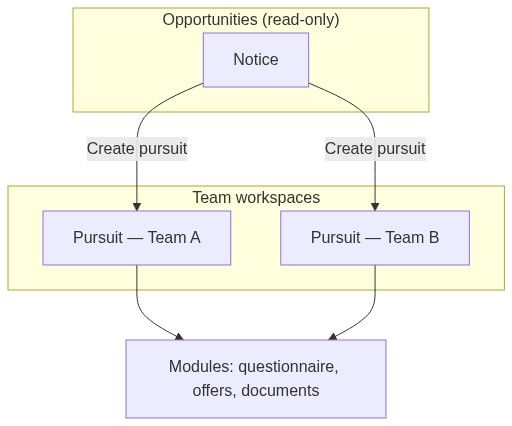
See Notice (Tender) for the market-intelligence side of this relationship.
How a pursuit differs from a notice
Creating a pursuit copies key facts at that moment. After creation, pursuit data stands on its own.
What copies at creation vs what stays independent
Copied from a notice (Path A only)
When you create from a synced notice, the pursuit inherits a snapshot:
You can refine these later on Pursuit overview. Wrong type or country early on means wrong sidebar modules — fix context before heavy questionnaire work.
Standalone pursuits (Path B)
You enter title, type, country, owner, and optional documents yourself. Nothing copies from the catalog. The card shows Source: standalone on Team → Pursuits.
Always independent after creation
Caution: You cannot attach a standalone pursuit to a notice later as a merge. If the tender appears in the catalog, create a new notice-linked pursuit instead.
Two ways to create a pursuit
Not every opportunity arrives through Opportunities → Notices. Both paths land in the same pursuit workspace afterward.
Path A — Create pursuit from a notice
Use this when the tender is indexed in Tendersight or matched an alert.
Open the notice from Notices browse, an alert, a dashboard widget, or Home assistant search.
On Notice overview, read description, key facts, lots, and documents.
If an obsolete-version banner appears, open the latest version before continuing.
Click Create pursuit in the command bar (or Go to pursuit if your team already has one).
If you belong to multiple teams, pick the team that will own the bid.
You land on Pursuit overview; the card appears on Team → Pursuits in Active.
See Create pursuit from notice for team-selection edge cases and the full copy table.
Path B — Standalone pursuit
Use this when the buyer sent documents by email, the tender sits on a portal Tendersight does not monitor, or you are responding to a private RFP.
Go to Team → Pursuits.
Click New standalone pursuit.
Complete the three-step wizard: Details → Documents → Review.
Enter title, pursuit type, country, owner, and optional uploads — there is no automatic link to an official notice reference.
See Create standalone pursuit for field-by-field guidance.
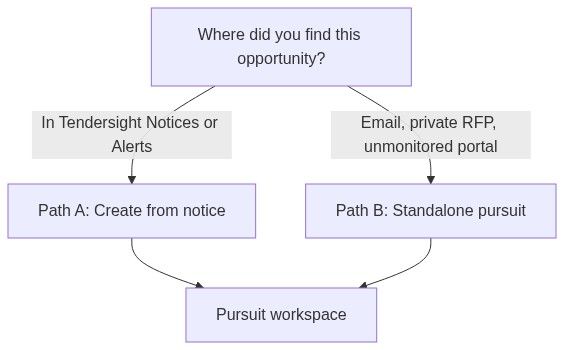
Caution: Choosing standalone when the notice is in the catalog means you lose automatic version tracking, official identifier links on the kanban card, and one-click Go to pursuit from the notice page. Prefer Path A whenever the tender is indexed.
Pursuit type and country — navigation and modules
Each pursuit has context: pursuit type (works, supplies, services) and country (European markets supported by Tendersight). Together they drive the pursuit sidebar — which modules appear, in which order, and under which section headings.
Country profiles stack universal rules per pursuit type with country-specific form volumes and modules. A works contract in Romania does not show the same sidebar as a supplies pursuit in Finland.
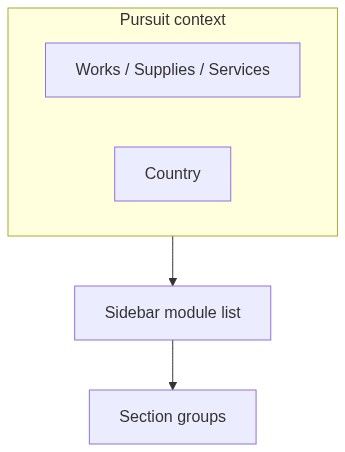
If context is incomplete (missing country or pursuit type), pursuit navigation shows a warning until you fill the fields on Pursuit overview. Incomplete context blocks some modules from unlocking fully.
See Pursuit overview for editable context fields and the linked-notice card.
Pursuit navigation sections
Modules group into sections. Exact items vary by country and pursuit type — the table below is typical, not exhaustive.
To start module work, open the pursuit from Team → Pursuits or from the notice's Go to pursuit button, then use the left sidebar.
Kanban and pipeline status
Team → Pursuits organizes every pursuit as a kanban board by status. Drag cards between columns or use the card menu to update pipeline state. Column headers show pipeline value (sum of estimated values) and pursuit count.
Recommended flow:
Create pursuit → card lands in Active.
Work through modules (questionnaire → offers → documents → final checkup).
Drag to Bid submitted when the authority receives your package.
Drag to Won or Lost when the outcome is known.
Filters on the board support deadline range, estimated value, owner, status, and source (notice-linked vs standalone). See Pursuits list.
Team overview also surfaces pipeline totals, upcoming deadlines, and onboarding checklists — pursuits feed those widgets from the same status and deadline fields.
Team settings and inventory — what feeds in from the side
Pursuits do not pull company legal data from notices. Complete team-level setup before heavy document work.
Team settings → pursuits
Incomplete settings produce "complete" placeholders in PDFs and skipped AI fill fields. Recommended order on team overview:
Configure alerts → Configure team settings → Import inventory → Start a pursuitSee How information flows and Team settings.
Team inventory → technical offer
Upload datasheet / CSV import / connected service sync ↓Team products with specifications ↓Pursuit technical offer (import or automapping) ↓Attribute mapping → Generated proposal textTeam products are your catalog; notice product extraction describes buyer requirements — you map buyer lines to your products inside the pursuit, not in Opportunities.
Optional team-level questionnaire setup — requirement categories and SME assignments — routes reviewers before large compliance matrices.
Key pursuit data and where it flows
Where pursuits appear
Actions, permissions, and limits
Who can work in a pursuit
You must be a member of the pursuit's team. Creating a pursuit requires membership on the selected team. Team owners, administrators, and collaborators can typically create pursuits when team policy allows.
Switch active team in the sidebar before creating from a notice — the button label reflects whether that team already has a workspace on the notice.
Full matrix: Permissions and access.
Subscription pursuit limits
Plans cap how many pursuits your team can create. When the limit is reached, creation fails with an upgrade message — contact your team admin or adjust billing. Limits apply to new workspaces, not to opening existing ones.
Delete consequences
Export or archive pursuits you need for records before deletion.
Recommended workflow
Prepare team — settings and optional inventory (Getting started workflow).
Discover — notice browse or alert lands you on an opportunity.
Validate — latest version, deadline, lots, documents (notice-backed only).
Create pursuit — Path A or Path B.
Set context — confirm pursuit type and country on overview.
Execute — in-depth analysis → questionnaire → offers → documents → final checkup (First pursuit workflow).
Track pipeline — drag kanban card through Active → Bid submitted → Won / Lost.
FAQ
What is the difference between a pursuit and a project?
Same workspace. Project appears in some translations and assistant phrasing; pursuit is the primary English label under Team → Pursuits.
What is the difference between a notice and a pursuit?
A notice is the authority's published opportunity (read-only, shared catalog). A pursuit is your team's private workspace to prepare a bid.
Can two teams share one pursuit on the same notice?
No. Each team gets its own pursuit. Team A cannot see Team B's questionnaire or pricing.
Can two people on the same team create duplicate pursuits on one notice?
No. The second attempt routes to the existing pursuit (Go to pursuit).
Can I create a pursuit without a notice?
Yes. Use New standalone pursuit on Team → Pursuits when the opportunity is not in the catalog.
Why does the button say "Go to pursuit" instead of "Create pursuit"?
Your current team already has a workspace on this notice. Clicking opens that pursuit directly.
What happens if the authority amends the tender after I created a pursuit?
The notice updates on sync; your pursuit does not auto-update. Review Notice versions, fetch new documents, and adjust questionnaire and offers manually.
Does deleting a notice delete my pursuit?
No. Notices are read-only imports; pursuits are separate team data. Deleting a pursuit does not delete the notice either.
Why are some sidebar modules missing?
Usually wrong pursuit type or country, or incomplete context. Update fields on Pursuit overview and refresh navigation.
Do I need team settings before creating a pursuit?
Strongly recommended. Without company profile, legal representative, and banking, generated documents show placeholders from day one.
Will standalone pursuits appear in market analytics as notices?
No. They are internal workspaces unless you later work from a synced notice-linked pursuit.
What happens to pursuits when I delete a team?
All pursuits and their documents are permanently removed with the team. Export anything you need before confirming deletion.
Related articles
Notice (Tender)
Team
Team product
Create pursuit from notice
Create standalone pursuit
Pursuits list / kanban
Pursuit overview
Team overview
How information flows
First pursuit workflow