How information flows
This article explains where information comes from in Tendersight, where it goes next, and why the order of setup matters. You do not need a technical background — think of it as a map from official tender publications to your team's submission pack.
Summary
This article explains where information comes from in Tendersight, where it goes next, and why the order of setup matters. You do not need a technical background — think of it as a map from official tender publications to your team's submission pack.
The big picture
Every bid in Tendersight starts as a notice imported from official procurement sources. Your team evaluates that notice, optionally monitors similar ones with alerts, researches buyers and competitors in analytics, then opens a pursuit to prepare the actual offer. Submission still happens on the authority's portal — Tendersight prepares your workspace; you submit externally.
```mermaid
flowchart TD
subgraph sources["Official sources"]
SEAP[SEAP Romania]
TED[EU TED]
NAT[Other national portals]
end
subgraph catalog["Opportunities — read only"]
N[Notices]
end
subgraph monitor["Monitoring and intelligence"]
AL[Alerts]
AN[Analytics]
end
subgraph decide["Your evaluation"]
OV[Notice overview]
ST[Statistics and dashboards]
end
subgraph workspace["Team workspace — your data"]
TS[Team settings and products]
P[Pursuit]
Q[Questionnaire]
TO[Technical offer]
FO[Financial offer]
DOC[Documents]
FC[Final checkup]
end
subgraph external["Outside Tendersight"]
SUB[External submission]
end
SEAP --> N
TED --> N
NAT --> N
N --> AL
N --> AN
N --> OV
AN --> ST
AL --> OV
OV --> P
TS --> P
P --> Q
Q --> TO
Q --> FO
TO --> DOC
FO --> DOC
DOC --> FC
FC --> SUB
```
Team settings and team products feed into pursuits from the side. They do not come from notices — you enter them once per team and reuse them on every bid.
Notices and analytics help you decide. Pursuits are where you execute.
Notice information and where it is used later
Notices are read-only. Tendersight syncs them from official systems; you cannot change title, deadline, or authority data on the notice record.
Important: When a newer version replaces the one you are viewing, Tendersight shows an obsolete version banner. Always open the latest version before creating a pursuit or downloading documents for analysis. A pursuit created on an older version does not auto-migrate when the authority publishes an amendment.
From discovery to evaluation
This is the path most teams follow before any pursuit exists — like adding an opportunity to a pipeline before you commit bid resources.
Discover — land on a notice from Opportunities → Notices, an alert email, analytics drill-down, or Home assistant search. Keywords match document text, not only the overview description.
Read the overview — confirm deadline, value, lots, documents, and latest version; use Add to calendar if needed.
Research — optional authority profiles, company statistics, and custom dashboards. Analytics never creates a pursuit — you still click Create pursuit when ready.
Decide — bid or no-bid using read-only data. Nothing is stored in your team workspace until you create a pursuit.
Alerts flow
Alerts turn Lead Finder filters into an automated watch. When a new or updated notice matches your rules, Tendersight records a trigger occurrence and notifies you on the schedule you chose.
Create a ruleset — Opportunities → Alerts → New ruleset (or Receive alerts from a notice you already like).
Name and scope it — personal or shared with your team; choose email digest frequency (immediate, daily, weekly).
Add filter rules — same filter types as Notices browse: keywords, country, CPV, value, deadline, authority, and more. All filters combine — every condition must pass.
Preview and save — review estimated match volume, then enable the ruleset.
Background matching — Tendersight compares new and updated notices against your rules automatically.
Notification — you receive email digest entries, in-app Activity rows, and optional dashboard widgets.
Open the notice — click through from email or Activity to the notice overview.
Evaluate and act — refine filters, research in analytics, or Create pursuit when you decide to bid.
Tip: Seed a ruleset from a notice you already evaluated — Receive alerts on the notice command bar copies its criteria so you do not rebuild filters from scratch.
Analytics flow — read-only intelligence
Analytics aggregates every indexed notice. It does not write back to notices or pursuits. Use it to improve bid/no-bid quality; use pursuits to prepare the submission.
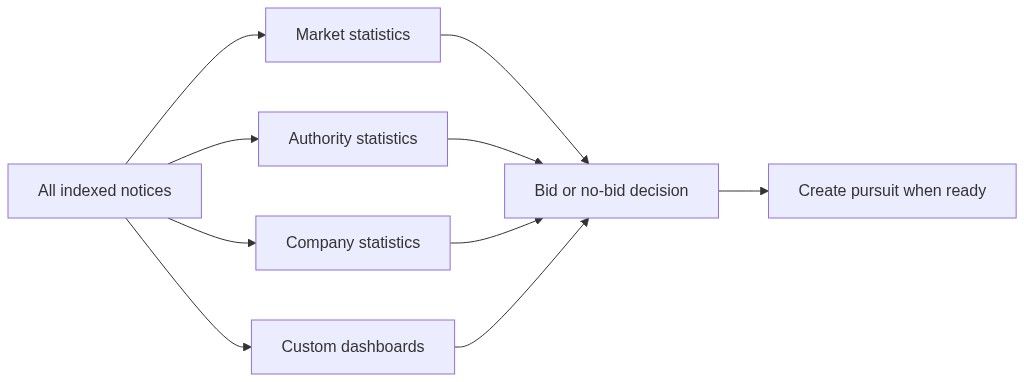
Opening a tender row from analytics still lands on the same read-only notice overview — the intelligence plane stops at the door of your workspace.
Team settings before your first pursuit
Complete Team → Settings before you create a pursuit. Pursuit documents and AI-assisted fillers pull legal identity from these sections from day one.
Caution: If team settings are incomplete when you create a pursuit, generated PDFs and AI-filled forms show "complete" placeholders where your company name, VAT, or banking details should appear. Fixing settings later does not retroactively update documents you already generated — you regenerate or edit those outputs manually.
"Team settings complete" means all three core sections saved at least once: company profile, legal representative, and banking information — not just the company name alone.
Verify the Configure team settings step on Team overview shows done before Start a pursuit.
Team products → technical offer
Your team product catalog lives under Team → Inventory → Products. It describes what your organization sells or supplies — not what the buyer asked for on the notice.

Tender products describe what the authority wants. Team products describe what you offer. You connect them inside the pursuit technical offer — import from inventory, run auto-solver suggestions, or add solution parts manually.
Works pursuits use a different module (works technical proposal) instead of the product-based technical offer editor.
Company profile fiscal match → analytics
When your team company profile fiscal identifier (VAT or equivalent registration number) matches a record in Analytics → Companies, Tendersight can personalize competitive views:
Update the VAT or registration number in Team → Settings → Company profile if your legal entity recently changed or the match never appeared.
Inside the pursuit — execution flow
Once you click Create pursuit on a notice (or finish the standalone pursuit wizard), work moves into your team workspace. Key facts copy from the notice at that moment; afterward pursuit data is independent.
Typical order: in-depth analysis → questionnaire → technical and financial offers → documents → final checkup → submit on the authority portal. Module availability depends on pursuit type and country.
Home assistant → platform actions
The Home assistant reads and acts across the product in plain language. Sensitive writes pause for your approval before executing.
Teammates' past chats in Recents open read-only — start New chat for your own writable session.
What happens when you delete something
Deletion is permanent unless noted. There is no undo for team or pursuit removal.
Deleting a team does not delete your user account or other teams you belong to.
Recommended onboarding order
Follow this sequence on Team overview → Getting started so each step has the data it needs for the next.
Tip: Use this checklist before your first real bid — skipping early steps creates rework inside the pursuit.
Finish account onboarding and reach Home
Configure at least one alert (or skip if you only browse manually)
Complete team settings — company profile, legal representative, banking
Optional: upload company logo
Import team products — manual, datasheet, CSV, or connected catalog
Optional: invite colleagues and set questionnaire routing
Open a notice → evaluate → Create pursuit
Inside pursuit: analysis → questionnaire → offers → documents → final checkup
Alerts and inventory can run in parallel with settings, but team settings must finish before the first pursuit if you want clean auto-fill from the start.
FAQ
Why can't I edit a notice deadline or title?
Notices are imported read-only from official sources. When the authority changes data, Tendersight syncs a new version — you review Versions timeline and update your pursuit plan manually.
Do alerts create pursuits automatically?
No. Alerts notify you of matches. You still open the notice and click Create pursuit when you decide to bid.
Does analytics change my pursuit data?
No. Analytics is a read-only intelligence plane. It helps you decide; pursuits hold your answers and offers.
What is the difference between tender products and team products?
Tender products are buyer requirements from notice documents. Team products are your catalog. You map them together in the pursuit Technical offer.
Can I create a pursuit before team settings are done?
Yes, but generated documents show "complete" placeholders until settings are filled.
Where does submission happen?
Tendersight prepares your pack through Documents and Final checkup. You submit on the authority's external portal — not inside Tendersight.
Related articles
Platform overview
Core concepts
Notice (Tender)
Pursuit
Team settings
Getting started workflow
First pursuit workflow
Market statistics